Introduction
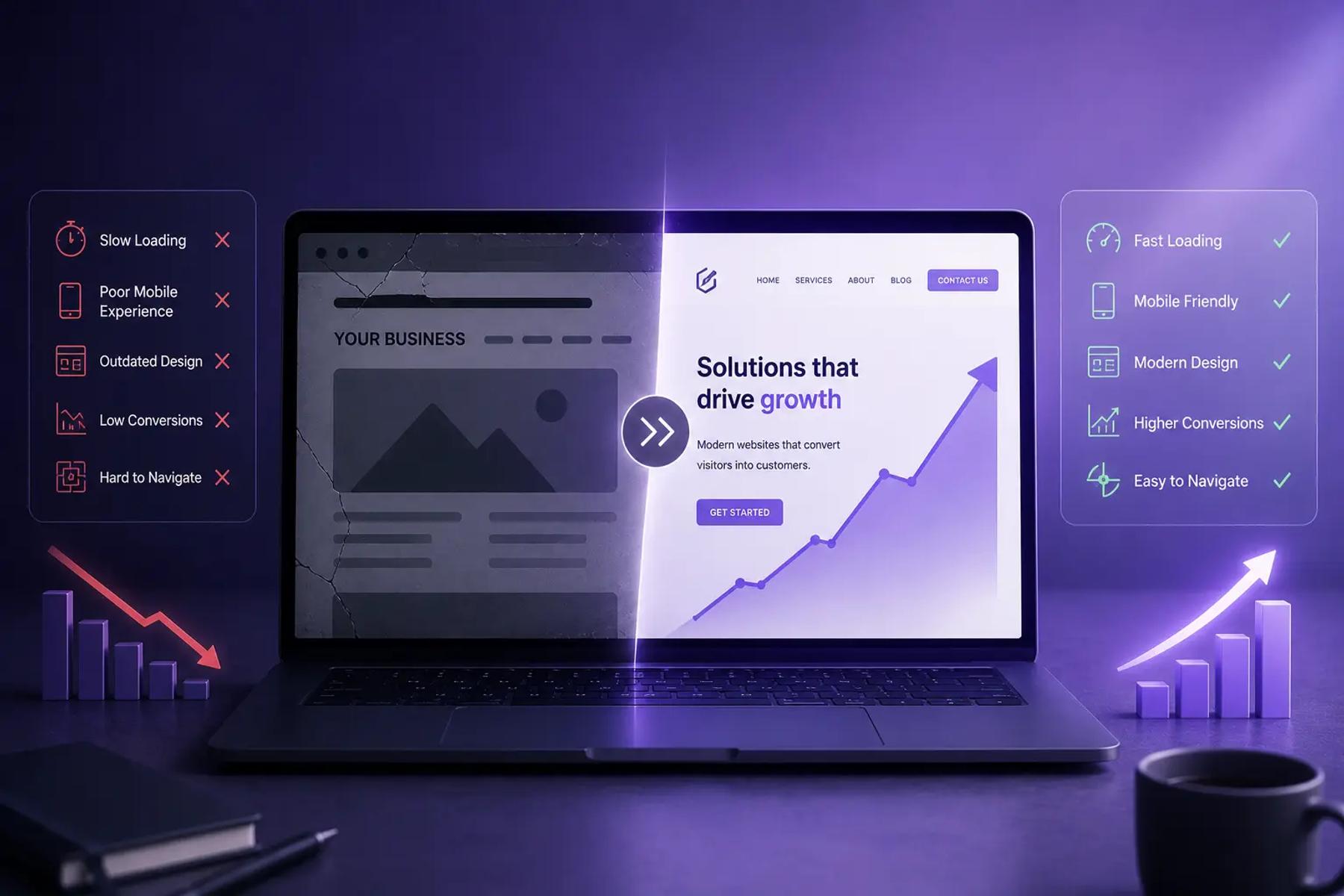
Your website is often the first place prospects and partners form an opinion about your business. If it’s slow, confusing, or outdated, that opinion can hurt growth even when your actual products and services are strong. Many companies don’t realize how much their site is costing them until they fix it.
This article outlines clear signs that your business website may be hurting your growth—and practical ways to fix them.
Sign 1: Outdated Design
If your site looks years behind your competitors, visitors may assume your business is behind as well. Outdated design can mean:
- Old-fashioned layouts — Dense text, cluttered sidebars, or visuals that feel generic.
- Inconsistent branding — Colors, fonts, or messaging that don’t match your current brand.
- No clear hierarchy — Important information doesn’t stand out.
Fix: Invest in a thoughtful redesign. Focus on clarity, whitespace, and a structure that guides visitors to key actions. A modern, coherent design builds confidence and professionalism.
Sign 2: Slow Loading Speed
Slow websites frustrate users and increase bounce rates. They also hurt search rankings, because speed is a ranking factor.
You might have a speed problem if:
- Pages take more than a few seconds to become usable.
- You’ve never measured performance (e.g. with Google PageSpeed Insights or Core Web Vitals).
- You’ve added many plugins, images, or scripts without optimization.
Fix: Run a performance audit. Optimize images (format, size, lazy loading), reduce unnecessary scripts, and consider better hosting or a more performant platform (e.g. moving from a heavy CMS to a modern framework). Even incremental improvements often yield noticeable gains.
Sign 3: Poor Mobile Experience
A large share of B2B and consumer traffic is on phones and tablets. If your site is hard to use on small screens—tiny text, broken layouts, or forms that don’t work—you lose engagement and credibility.
Fix: Ensure your site is fully responsive. Key pages and forms should work smoothly on mobile. Test on real devices, not only in a browser resize. Mobile experience should be a requirement, not an afterthought.
Sign 4: Confusing Navigation
Visitors should quickly find:
- What you do — Services or products.
- Who you help — Your audience or industry.
- How to contact you — Clear calls to action.
- Proof and trust — Case studies, testimonials, or credentials where relevant.
If people have to hunt for these, they leave. Complex or inconsistent navigation is one of the most common growth killers.
Fix: Simplify the menu and information architecture. Group content logically, use clear labels, and put the most important actions (e.g. Contact, Get a quote) where they’re easy to see. User testing can reveal where people get stuck.
Sign 5: Weak or Unclear Messaging
If visitors can’t quickly understand what you do, who you help, and why you’re different, they won’t stay or convert.
Signs of weak messaging:
- Generic taglines that could apply to any company.
- Jargon or internal language that outsiders don’t get.
- No clear value proposition above the fold.
Fix: Clarify your value proposition and audience. Use plain language. Put the most important message and benefit front and center. Test headlines and key paragraphs with real customers or prospects if you can.
Sign 6: Low or No Lead Generation
A business website should support growth. If it rarely generates inquiries, the problem is often one or more of the above—or missing or unclear calls to action.
Check:
- Are contact forms easy to find and simple to complete?
- Do you offer a clear next step (e.g. “Request a quote,” “Book a call,” “Download a guide”)?
- Is there a path from every important page to that next step?
Fix: Add or improve calls to action. Make forms short and relevant. Offer something useful (e.g. an audit, a guide, or a consultation) in exchange for contact details. Track where traffic comes from and where it drops off so you can improve the journey.
Sign 7: You’re Ashamed to Share It
If you hesitate to send your website to a prospect or partner, that’s a signal. You’re already aware it doesn’t represent you well.
Fix: Treat that feeling as a prompt to act. List what bothers you (design, speed, content, clarity) and tackle the highest-impact items first. Even a focused round of improvements can make the site something you’re proud to share.
How to Fix These Problems Systematically
A structured approach usually works better than ad-hoc tweaks:
- Audit — Review design, speed, mobile experience, navigation, messaging, and conversion paths. Use analytics and, if possible, feedback from customers or sales.
- Prioritize — Decide what to fix first (e.g. speed and mobile, then messaging and CTAs).
- Redesign or refresh — Depending on the scope, plan a full redesign or a series of targeted improvements.
- Improve technology if needed — Sometimes the platform itself is the bottleneck. Migrating to a faster, more maintainable stack can unlock lasting gains.
- Launch and iterate — Go live with improvements, then refine based on data and feedback.
Working with an agency that specializes in business and B2B websites can speed this up and help you avoid common mistakes.
Conclusion
Your website should support business growth, not limit it. Outdated design, slow speed, poor mobile experience, confusing navigation, weak messaging, and low lead generation are all fixable. Identifying and addressing these issues often leads to more inquiries, better perception, and stronger long-term results.
If you’re ready to turn your site into a growth asset, RavenPixels helps businesses build fast, clear, and conversion-focused websites. Get in touch for a conversation about your goals and next steps.