Introduction
Bihar’s industrial base — chemicals, food ingredients, engineering suppliers, and export-oriented MSMEs — runs on relationships, certifications, and proof of capability. Buyers still ask for samples and site visits. Before any of that happens, they look you up online.
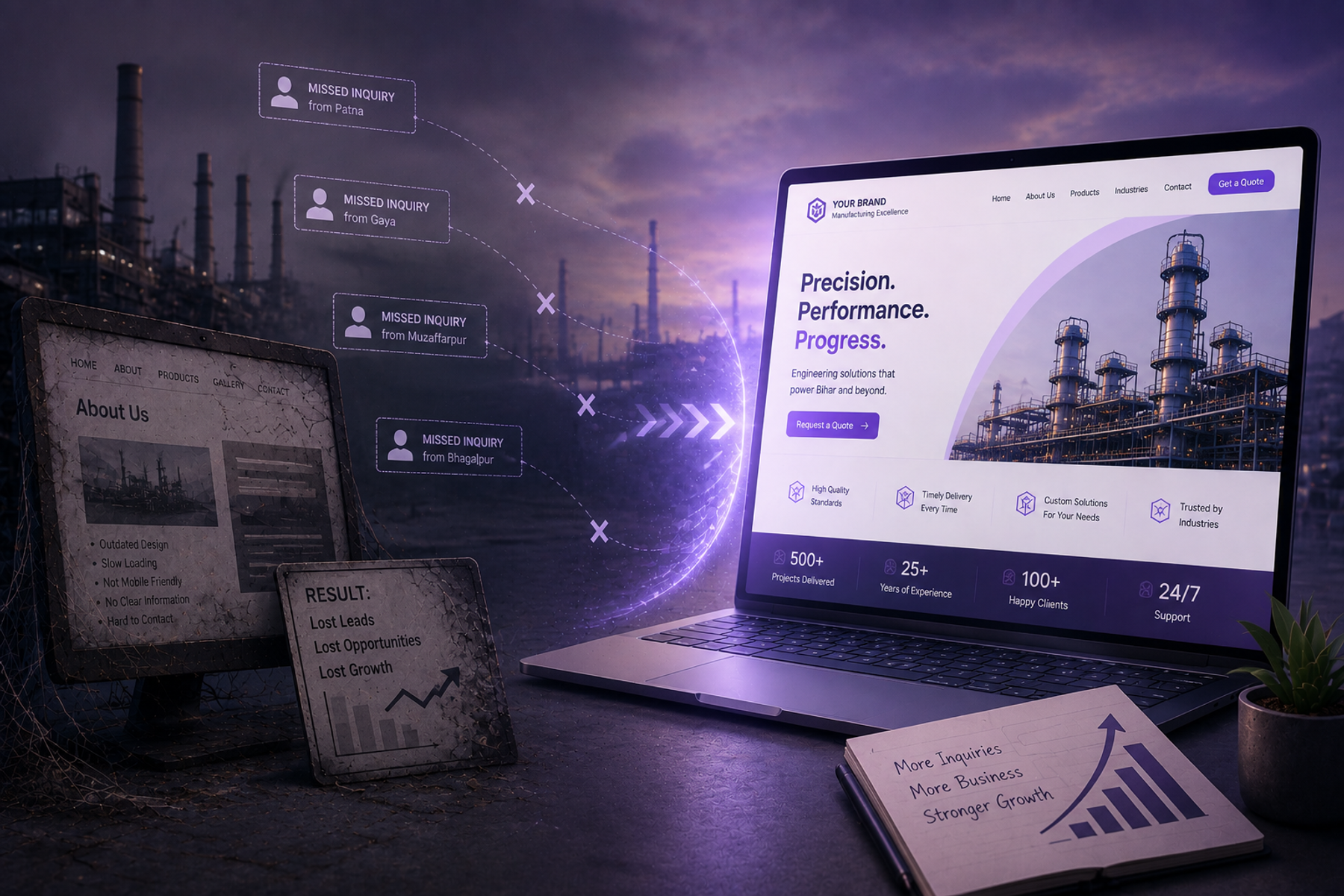
When the website looks dated, loads slowly on mobile, or hides products behind PDFs and broken menus, the lead does not always complain. They simply choose a competitor whose digital presence matches the seriousness of their operation.
This is not a “pretty website” problem. It is a lead-quality and trust problem for manufacturing and export businesses serving Patna, Bihar, and national or overseas buyers.
Weak Sites Fail Before Sales Gets a Call
Industrial buyers evaluate vendors in layers: capability, compliance, logistics, price. Your site is the first filter.
Common failure modes we see on legacy B2B sites:
- No clear product hierarchy — Capabilities are buried in unstructured pages or image galleries with no specs, grades, or application notes.
- Mobile friction — Procurement teams and distributors research on phones; slow pages and tiny tap targets end sessions early.
- Missing proof — Certifications, export readiness, and quality processes are mentioned in brochures but not easy to find on the site.
- Broken inquiry paths — Contact forms that do not confirm submission, RFQ flows that ask for data you already have, or WhatsApp numbers that are not clickable from mobile.
Each issue alone might seem small. Together they signal that the business is not ready for serious B2B or export conversations — even when the factory floor is.
Export and Distributor Buyers Judge Faster Than You Think
Export houses, trading companies, and OEM procurement teams compare multiple suppliers in one sitting. They are not reading every word on your About page. They scan for:
- Product categories and MOQ or packaging clarity
- Export documentation or compliance pages (where applicable)
- Evidence of scale — plants, labs, quality systems — without stock-photo fluff
- A fast path to inquiry with context (product line, destination market, volume)
If your site still reads like a 2014 theme demo, you lose consideration before email ever opens. That is especially costly in Bihar’s manufacturing and trading corridors, where word-of-mouth is strong but new buyers start on Google, not in your existing network.
Performance Is a Sales Problem, Not an IT Metric
Slow sites are not just annoying. For image-heavy manufacturing catalogs, performance directly affects whether a buyer waits long enough to reach your RFQ form.
Documented modernization work shows the gap clearly. PIE Chemicals (chemical manufacturing) achieved a 65% faster load time and 2× user engagement after rebuilding their corporate site with clearer product hierarchy and mobile experience. Flavour Base India moved off an outdated WordPress setup to a modern platform and saw a 60% faster load time, with stronger product presentation on mobile.
Those results came from architecture and content structure — not from adding another plugin or slider.
What to Fix First (Practical Priority)
You do not need a full rebuild tomorrow to stop bleeding credibility. Start with what buyers hit first:
- Homepage and top product lines — One sentence on who you serve, three clear entry points (products, quality/export, contact/RFQ).
- Mobile load on product pages — Compress hero images, lazy-load galleries, test on a mid-range Android on 4G.
- RFQ or contact flow — Fewer fields, confirmation message, and a visible phone/WhatsApp path for local buyers.
- Trust block — Certifications, years in business (if accurate), client logos only where you have permission to display them publicly.
- Internal links to services you actually sell — If you are planning a redesign, tie evaluation to website redesign or website development scope, not vague “digital transformation.”
Businesses serving Patna and Bihar remotely can align local discovery with a dedicated Patna & Bihar service-area page — without implying a storefront office you do not operate.
When a Redesign or Migration Makes Sense
If your team spends more time fixing the site than updating product lines, or if migration from WordPress (or another legacy CMS) is on the table, treat it as a continuity project: URL inventory, redirects, content migration, and form testing — not a theme swap.
Custom website projects at Raven Pixels start from ₹40,000+; advanced platforms with deeper catalogs or integrations are scoped after discovery. Timelines for most custom builds run 3–6 weeks, depending on content readiness and migration complexity.
Closing: Match Your Site to Your Shop Floor
Manufacturing and export firms in Bihar compete on quality and delivery. Weak websites quietly disqualify you from RFQs you never knew you lost.
Start with buyer paths: product clarity, mobile speed, and inquiry flows that work. When you are ready to modernize performance and structure together, a structured audit beats guessing.
Next step: Get a free website audit — we review speed, mobile experience, and lead paths for B2B and industrial sites, remote-first for Patna, Bihar, and clients globally.