Introduction
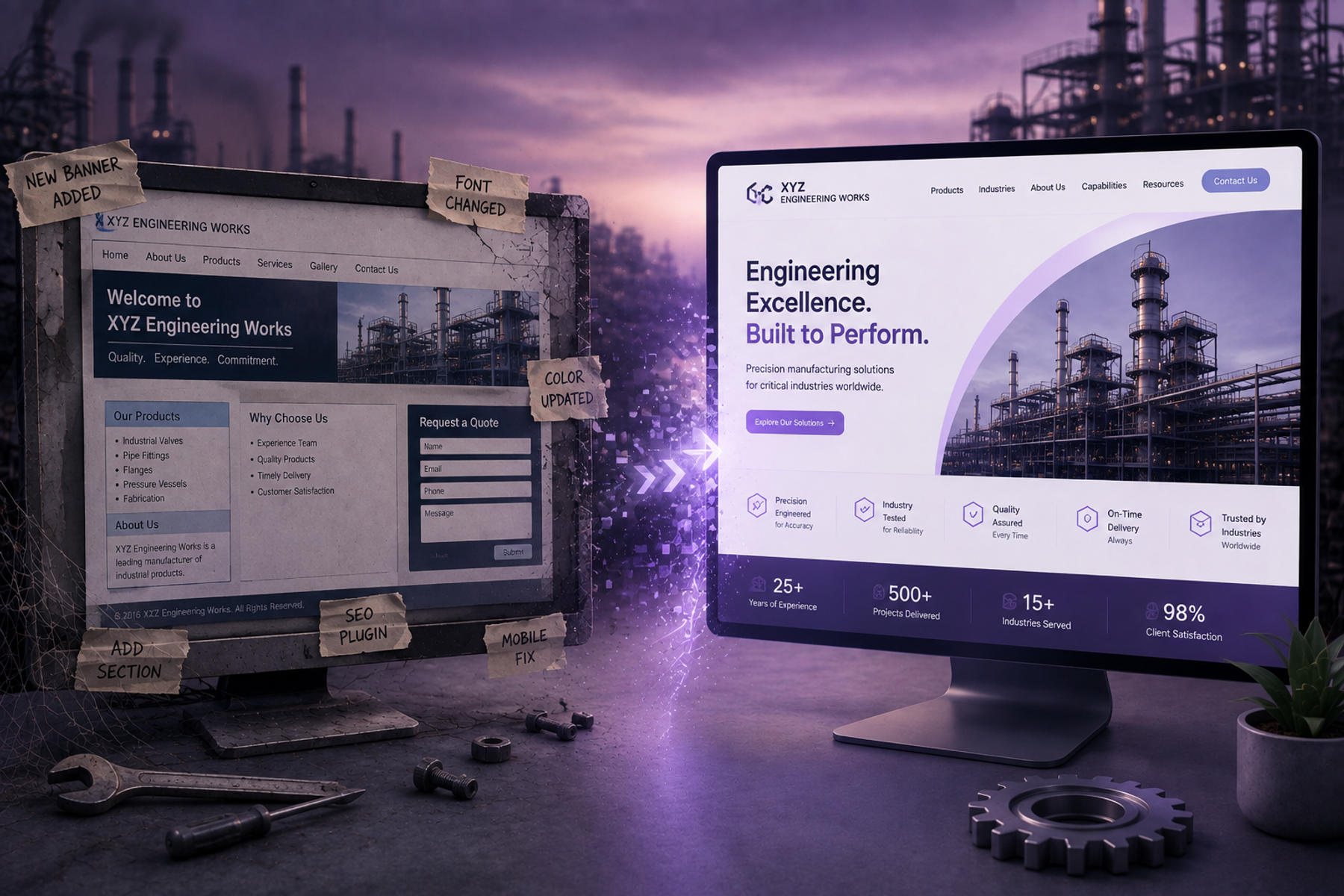
Manufacturing companies rarely set out to redesign a website. They patch it — a new banner, another plugin, a mobile theme that almost works. That cycle can run for years while RFQs quietly go to competitors whose sites load fast and show what they make in the first scroll.
A manufacturing website redesign is not a cosmetic refresh. It is a reset of structure: how products and capabilities are organized, how buyers request quotes, and how the site performs under real catalog weight. This article helps you decide when patchwork has stopped working, what a credible redesign should include, and how to plan the work without breaking SEO or inquiry flow.
Signs You Are Past “Quick Fixes”
Not every slow page needs a rebuild. These patterns usually mean incremental fixes will cost more than a structured redesign:
- Product information is hard to navigate — Buyers bounce between PDFs, duplicate pages, and category menus that do not match how you sell.
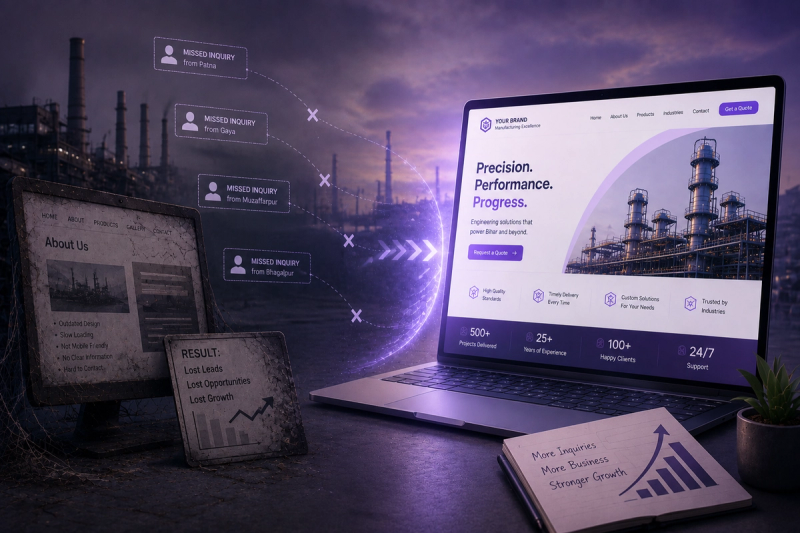
- Mobile RFQs fail — Forms break, phone numbers are buried, or key spec tables do not render on phones.
- Performance degrades as you add content — Each new product line or certification page slows the whole site because the underlying stack was never built for scale.
- Marketing and ops disagree on updates — Simple text changes require a developer or agency ticket because the CMS or theme is fragile.
- The site no longer matches how you operate — New lines, export focus, or quality credentials are absent because the old IA cannot accommodate them.
If two or more of these are true, a website redesign scoped for manufacturing buyers is usually cheaper than another year of plugin debt.
What a Manufacturing Redesign Should Deliver
Industrial buyers are not comparing your homepage to a D2C brand. They are checking fit: can you supply, are you credible, is it easy to start a conversation.
A strong manufacturing redesign typically includes:
- Product and capability hierarchy — Categories, specs, and applications findable without hunting; room for certifications and quality notes where they matter.
- Clear inquiry paths — RFQ, contact, and distributor flows that work on desktop and mobile, with sensible form fields for B2B (not consumer checkout noise).
- Performance under heavy pages — Optimized images, sensible caching, and architecture that stays fast as the catalog grows. See performance optimization when speed is the primary pain.
- SEO-ready structure — Clean URLs, logical headings, and internal links between products, industries, and location/service pages.
- Maintainable content workflow — A CMS or stack your team can update without fear of breaking layout.
Raven Pixels builds website development and redesign projects for manufacturing and B2B companies with that bar — custom UI/UX, mobile-responsive layouts, performance work, and lead-generation structure. Projects start from ₹40,000+ for standard websites; advanced platforms and deep migrations are scoped separately.
Redesign vs. Migration: Plan the Risk First
Many manufacturing sites still run on WordPress or legacy themes. A redesign often overlaps with modernization — new design plus a move to a faster stack, content migration, and redirect planning so Google and bookmarked URLs keep working.
Documented modernization work on Raven Pixels projects includes 65% faster load time for PIE Chemicals and 60% faster load time after moving Flavour Base India from WordPress to a modern stack. Those are project-specific outcomes, not guarantees for every site — but they show what structured rebuilds target: speed, clarity, and easier long-term maintenance.
If you are weighing stack choices, the live article Next.js vs WordPress compares trade-offs without replacing a migration plan.
A Practical Planning Checklist
Before you sign a redesign proposal, pressure-test it against your buyers’ journey:
- Inventory top entry pages — Which products, categories, and location pages drive inquiries today? They need equivalents or redirects on day one.
- Define “done” for mobile — Can a buyer read specs and submit an RFQ on a mid-range phone without zooming?
- List must-keep URLs — Export a redirect map for anything indexed or linked from email signatures and catalogs.
- Align sales on form fields — What does inside sales need on first contact (volume, application, region)?
- Budget for content, not just design — Rewriting product pages and migrating PDFs often takes longer than the homepage mockup.
Serving Patna and Bihar as a remote-first service area, Raven Pixels works with manufacturers across India and global clients — no claim of a physical Patna office unless one is confirmed separately.
Closing: Make the Site Match the Plant
Your facility and quality systems may be strong while the website still reads like 2016. Buyers assume the digital experience reflects operational discipline. When patchwork stops moving the needle, a manufacturing website redesign is how you align credibility, RFQ flow, and performance with how you actually sell.
Next step: Get a free website audit — we review speed, structure, and conversion paths and outline whether redesign, migration, or targeted optimization fits your situation.