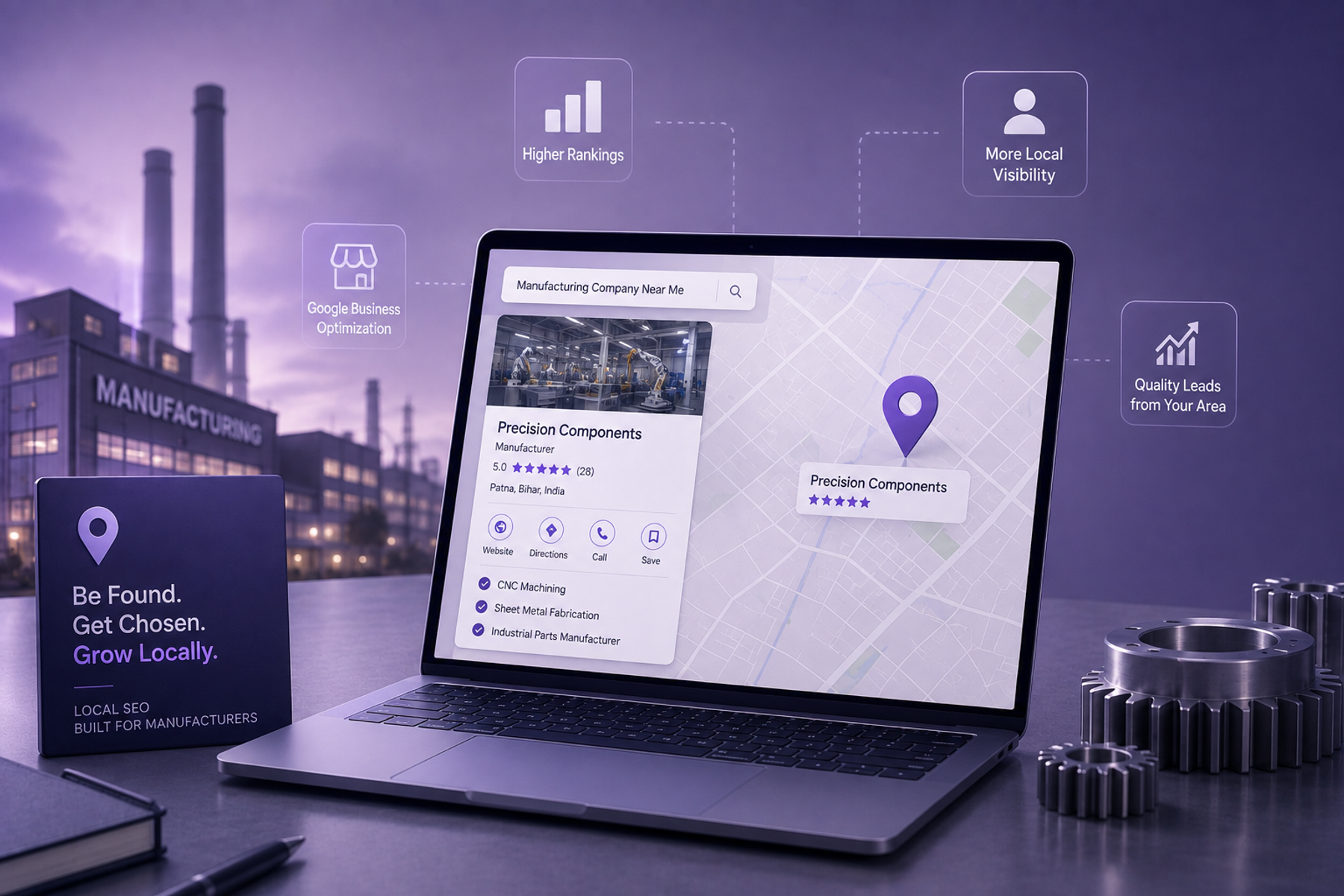
Introduction
Manufacturing and industrial buyers are not only comparing catalogs on marketplaces. Many RFQs still begin with a specific search: a city or region plus a process, material, or certification need. That is local intent in practice — even when your finished goods ship nationally or overseas.
If your plant serves Patna, Bihar, or broader India remotely, local SEO is not about pretending you run a retail storefront. It is about making your service area, capabilities, and contact paths visible wherever buyers start looking — Maps, organic results, and your own site.
This guide covers what B2B manufacturers should prioritize on Google Business Profile (GBP), on-site structure, and consistency — without keyword stuffing or unverifiable location claims.
Why “We Only Sell Globally” Still Misses RFQs
Export-focused teams often deprioritize local visibility because international orders feel larger. That logic ignores how procurement actually works:
- Regional suppliers win work when a buyer needs speed, site visits, or a known industrial cluster nearby.
- City + capability queries (“industrial coating near me,” “precision machining Patna,” “food ingredient supplier Bihar”) signal someone ready to inquire, not browse inspiration boards.
- Maps and local pack results surface businesses with complete profiles and clear categories — not whoever has the flashiest brochure PDF.
A global catalog does not replace local and regional discovery. It runs in parallel. Your site should speak to export buyers and to buyers searching by geography plus technical fit.
Google Business Profile for Service-Area Businesses
Raven Pixels operates remote-first, serving Patna and Bihar and clients globally — there is no public street address on the marketing site, and that is intentional. Many agencies and B2B vendors should list as a service area business (SAB) on Google, not as a storefront with a pinned address you cannot staff daily.
If you are setting up or refreshing GBP for a manufacturing-adjacent service (web development, industrial marketing, or your own plant’s listing), align with how Google expects SABs to work:
- Primary category should match what you actually do (for example, “Manufacturer,” “Industrial equipment supplier,” or “Website designer” — pick the closest truthful category).
- Service areas should reflect real delivery or sales coverage — cities and states you can serve without inventing a fake office.
- Services list should mirror real offerings (fabrication, coating, redesign, performance optimization — not a keyword dump).
- Photos and posts should show real facilities, products, or completed work you are allowed to share — not stock renderings.
Incomplete or static profiles lose visibility when buyers compare options in Maps. Treat GBP as a living asset: update services when you add capabilities, refresh photos after real projects, and keep the phone number and website URL identical to what appears on your site.
What Your Website Must Support
Local SEO fails when Maps says one thing and your site says another. For manufacturers, the site should make capabilities and geography crawlable — not buried only in PDF datasheets.
Practical on-site checklist:
- Consistent NAP-style facts — business name, phone, and primary contact email match GBP and directory listings (IndiaMART, JustDial, trade directories if you use them).
- Dedicated location or service-area pages when you serve specific regions — explain what you deliver there without claiming a physical office unless one exists publicly.
- Capability and industry pages that answer how buyers search (process, material, certification), linked from navigation — see how manufacturing positioning is structured on manufacturing websites.
- Clear RFQ or contact paths on mobile — local clicks often happen on a phone between plant visits.
- Internal links from blog posts and case studies to services, industries, and Patna and Bihar service-area information where it fits naturally.
Technical SEO foundations (fast loads, sensible metadata, sitemaps) matter because Google still has to crawl and trust the site. Performance work is part of credibility: documented modernizations such as PIE Chemicals (65% faster load time after a full site rebuild) and Flavour Base India (60% faster load time after moving off an outdated WordPress setup) show what happens when industrial sites treat speed and structure as part of the sales story, not an IT side quest.
Directories, Reviews, and What Not to Fake
Local rankings for competitive categories still lean on profile completeness and ** genuine reviews** from real clients. For B2B manufacturers and their vendors:
- Submit consistent listings to directories your buyers actually use in India — trade and B2B platforms, not only generic social profiles.
- Ask satisfied customers for specific reviews (what you delivered, timeline, communication) — avoid incentivized or bulk fake reviews; they are a compliance and trust risk.
- Do not publish street addresses, review counts, or awards in schema or ads unless they are verified and public — contradictory claims across site, GBP, and ads erode trust fast.
If you later establish a registered office or co-working address you can receive mail at and staff by appointment, you can revisit listing type with your own legal and operations input. Until then, service-area framing is more honest and easier to maintain.
How This Connects to Website Projects
Local SEO is not a plugin you bolt on after launch. SEO-ready architecture — clean URLs, location and capability pages, structured internal links, and forms that work on mobile — is part of website design and redesign scope.
Website projects at Raven Pixels start from ₹40,000+; advanced platforms with deeper catalogs or integrations are scoped after discovery. Typical custom builds run on a 3–6 week timeline depending on content readiness and migration work.
If you are unsure whether your current site and GBP tell the same story, start with a structured review rather than guessing.
Next Step
Request a free website audit to see where capability pages, performance, and local signals align — or where RFQs may be leaking before sales ever hears from a buyer. Visit /audit or /contact to get started.