Introduction
If your business site runs on WordPress today, you have probably lived through plugin updates, slow admin screens, and a theme that no longer matches how you sell. Moving to a modern stack — often Next.js for the front end — can fix performance and flexibility. It is also a project, not a weekend toggle.
For Patna and Bihar manufacturers, exporters, and B2B service firms, the decision is rarely “WordPress bad, Next.js good.” It is whether your current platform still supports credibility, speed, and clear product storytelling — and what it takes to migrate without losing search visibility or breaking inquiry forms.
This guide covers when migration makes sense, what to plan before you start, and how to reduce risk for a business site that already has URLs, content, and buyer trust in place.
When WordPress Still Works — and When It Does Not
WordPress can still be the right tool for content-heavy blogs, small teams that live in the admin UI, and sites with modest performance needs. Many industrial companies outgrow it when:
- Product and capability pages multiply — Heavy imagery, technical specs, and nested categories strain themes and plugins.
- Mobile performance slips — Buyers research on phones; slow capability pages cost inquiries before sales hears from anyone.
- Updates become fragile — Plugin conflicts, security patches, and theme debt eat time that should go to the business.
- You need a clearer B2B story — RFQ paths, certification pages, and export-ready content need structure, not another page builder block.
Migration is worth evaluating when maintenance cost and buyer experience both trend the wrong way — not because a new framework is trending on developer Twitter.
What “WordPress to Next.js” Actually Involves
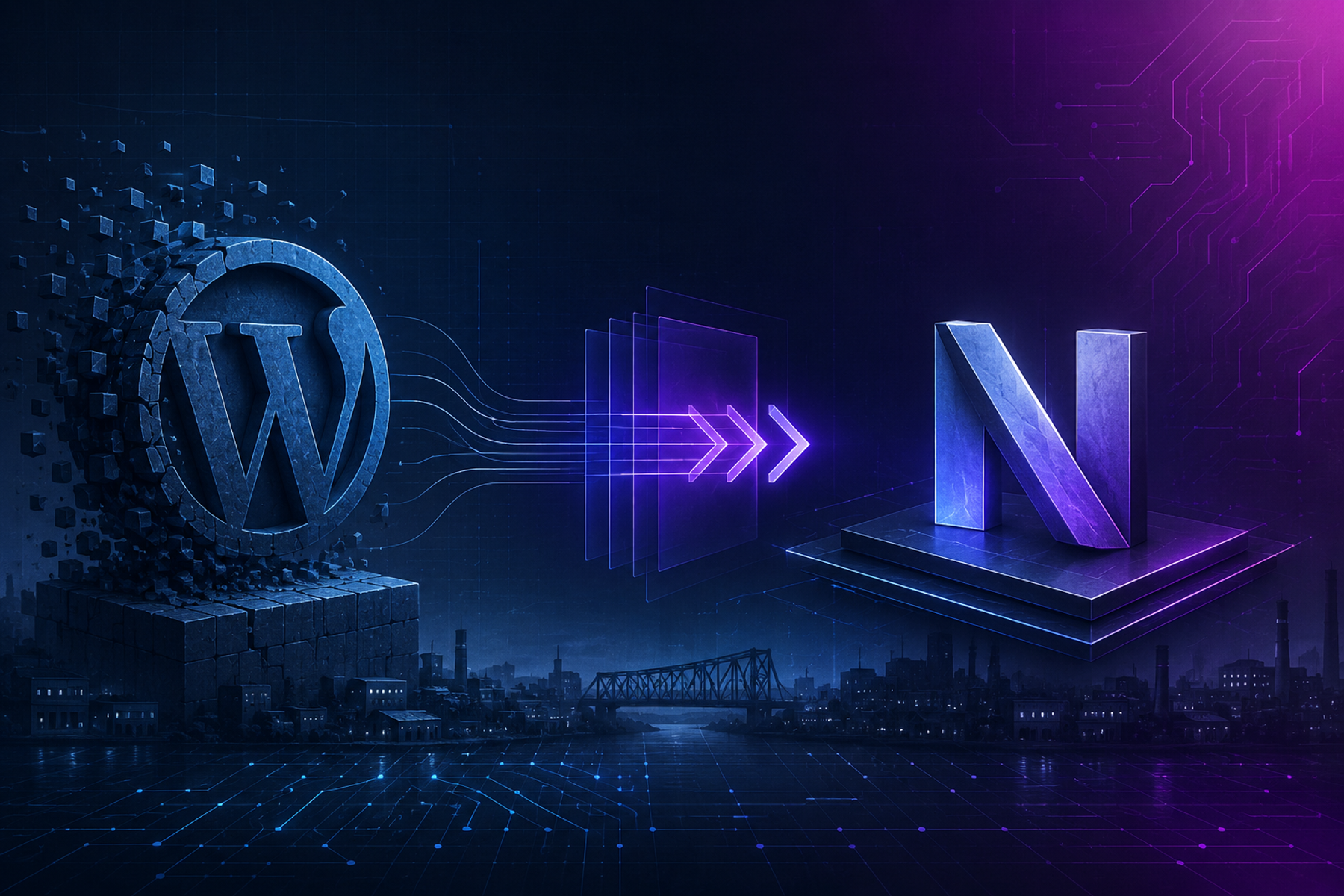
Next.js is a React-based framework for building fast, scalable web applications. In a typical modernization project, WordPress is not always replaced like-for-like on day one. Common patterns include:
- Headless or decoupled content — Keep structured content in a CMS; render pages with Next.js for speed and control.
- Full rebuild with content migration — Redesign UI, rebuild templates, and move posts, pages, and media into the new system.
- Hybrid launch — Ship critical marketing and product pages first, then retire legacy sections in phases.
For a Patna or Bihar business with an existing domain, the technical work is only half the picture. You also need discovery on what must stay live, what can be retired, and who owns content during the move.
SEO and Redirects: Do Not Skip This
The most expensive migration mistake is launching a beautiful new site that drops rankings because URLs changed without redirects.
Before build starts, inventory:
- Every indexed URL that drives traffic or links (use Search Console and analytics if available)
- Product, capability, and location pages buyers bookmark
- Blog posts that support long-tail searches
- PDFs or legacy paths still linked from emails or directories
During launch, plan for:
- 301 redirects from old URLs to the closest equivalent page on the new site
- Consistent title tags and headings where the topic is the same — avoid rewriting every URL slug without reason
- XML sitemap and robots configured for the new structure
- Structured internal links to services, industries, and contact or audit paths
A migration without a redirect map is a rebranding exercise that search engines read as a new site. For local and commercial queries — including terms like website redesign or development in Patna and Bihar — continuity matters.
Content, Media, and Forms
Industrial sites carry more than blog posts. Migration scope should name how each asset moves:
- Product and capability copy — Often needs editing during migration, not a blind copy-paste from old templates.
- Images and documents — Compress and alt-text as you move; heavy galleries are a common performance bottleneck.
- Forms and inquiry flows — RFQ, contact, and distributor inquiries must be tested on mobile before go-live.
- Integrations — Analytics, CRM hooks, and email routing should be verified in staging.
Real modernization work follows this pattern. Flavour Base India moved from an outdated WordPress site to a modern platform and saw a 60% faster load time, with clearer product presentation and better mobile experience. PIE Chemicals (chemical manufacturing) achieved a 65% faster load time after a full site modernization — performance and credibility were built into the new architecture, not patched later.
Those outcomes came from structured design and development, not from swapping themes on the same hosting plan.
Timelines, Cost, and Choosing a Partner
Most custom website and modernization projects run on a 3–6 week timeline depending on scope, content readiness, and migration complexity. Website projects at Raven Pixels start from ₹40,000+; advanced platforms with deeper catalogs or integrations are scoped after discovery.
When comparing vendors for a WordPress to Next.js path, ask:
- How will redirects and SEO continuity be handled?
- Who migrates content, and what is excluded?
- What performance targets apply (Core Web Vitals, mobile load on product pages)?
- What do you own after launch — code, hosting access, CMS credentials?
Prefer a partner who maps to manufacturing and B2B buyers, not only brochure sites. See Website Modernization & Migration for how we approach redesigns, and Next.js vs WordPress for a stack comparison — this article focuses on your migration plan, not a generic debate.
Closing: Migrate With a Checklist, Not Hope
Leaving WordPress for Next.js can improve speed, maintainability, and how seriously buyers take your digital presence — if you treat migration as a business continuity project.
Start with URL and content inventory, define redirect rules, and align the new information architecture with how Patna and Bihar buyers actually evaluate suppliers. Remote-first teams can serve Patna and Bihar without implying a street-level office; what matters is a site that performs and a clear path to inquire.
Get a Free Website Audit to review performance, structure, and migration risk on your current site — or schedule a consultation to scope a modernization path that fits your product story and timeline.
Brand review — 2026-08-03
File: content/marketing/drafts/blog/2026-08-03-wordpress-to-nextjs-migration-patna.mdx Status: Approved Notes: Pricing (₹40,000+), timeline (3–6 weeks), and case-study metrics (60%/65% load-time improvements) match services and case-study docs. No Patna office claim; service-area framing only. CTAs point to /audit and consultation language consistent with about/services docs. Internal links use real routes. No hype or fabricated stats.